What is Openstack?
-
Published on 18 Sep 2026
-
Last updated 18 Sep 2026
-
Reading Time 5 minutes
OpenStack has a prominent place in the world of cloud computing. Some call it the "king of the cloud," and with many companies planning to move away from VMware, OpenStack is attracting more attention than ever.
-
An Introduction to OpenStack
OpenStack has a prominent place in the world of cloud computing. Some call it the "king of the cloud," and with many companies planning to move away from VMware, OpenStack is attracting more attention than ever.
OpenStack emerged in 2010 through a collaboration between industry leaders NASA and Rackspace. Since then, it has become a leading open-source cloud platform that gives organizations exceptional flexibility, scalability and control over their IT infrastructure.
-
A Brief History of OpenStack
The OpenStack story began in 2010, when NASA needed scalable infrastructure to support its scientific research projects. NASA joined forces with Rackspace, a leading cloud provider, to develop an open-source cloud computing platform that could compete with proprietary solutions and promote innovation across the cloud industry.
At the time, NASA and Rackspace were working on similar technologies. Rackspace was developing compute and networking components, while NASA was working on storage components. Although the two organizations had never worked together, they had selected the same programming languages, frameworks and architectural approach, and were even using the same networking hardware. A few weeks later, OpenStack was born.
OpenStack's first release, code-named "Austin," marked the beginning of a new era in cloud computing. Since then, OpenStack has evolved rapidly and achieved widespread adoption with the support of a growing global community of developers, contributors and users.
-
What is Openstack?
At its core, OpenStack is a collection of open-source software modules that work together to orchestrate and manage cloud infrastructure resources such as servers, storage devices and network switches.
As a data center operating system, OpenStack provides services ranging from compute and storage to networking and identity management. It enables organizations to build and operate private, public and hybrid clouds. These resources are controlled across the data center and are managed and provisioned through APIs using shared authentication mechanisms.
OpenStack pools and manages compute, storage and networking resources to provide Infrastructure as a Service (IaaS) capabilities. It is one of several open-source technologies that help IT teams build and manage cloud workloads, and it is often viewed as an alternative to large-scale cloud platforms such as Google Cloud, AWS and Azure.
OpenStack also provides a user-friendly web dashboard that allows users to provision resources while giving administrators full control over the environment.
-
Core Openstack Components
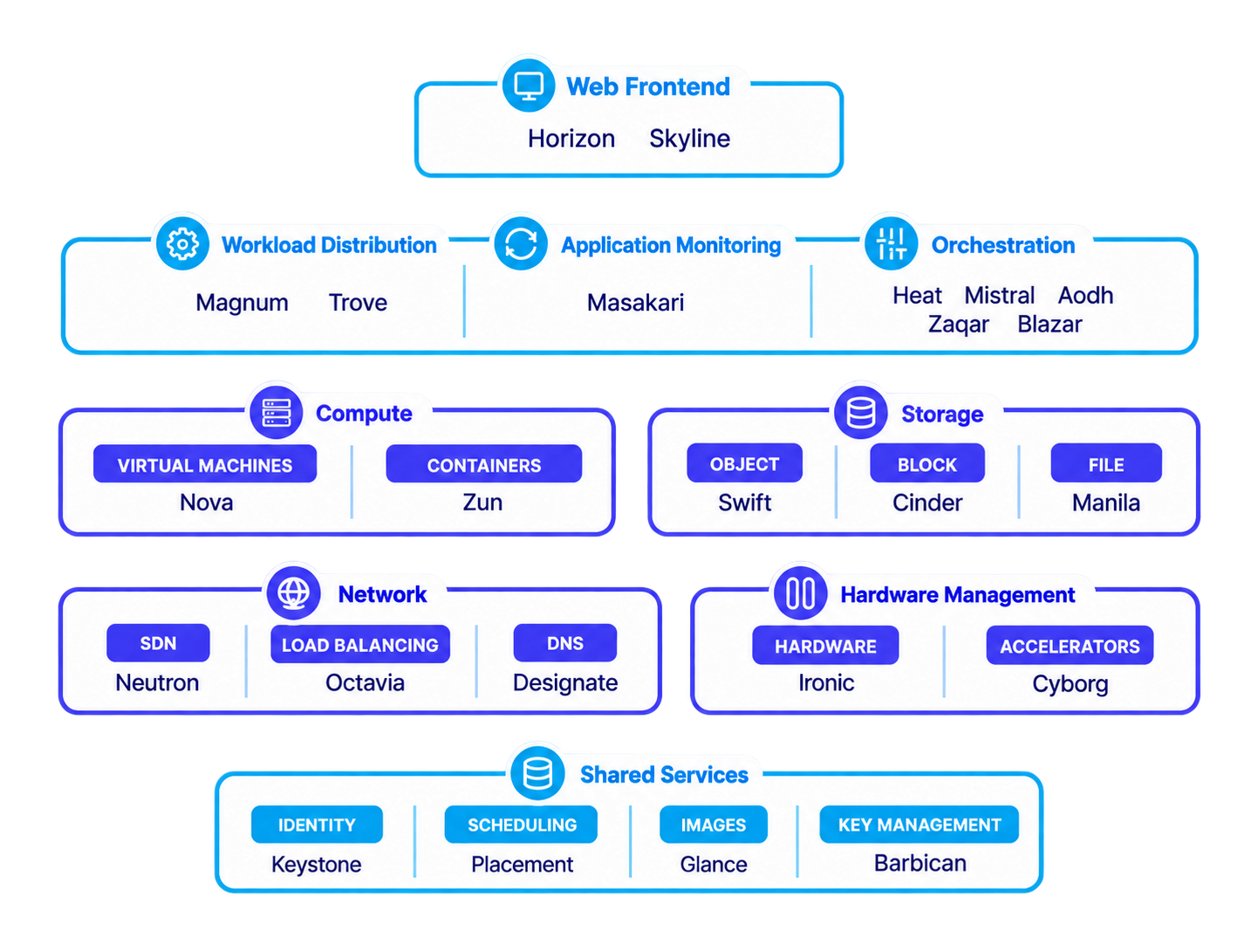
Keystone (Identity): Provides authentication and authorization services for secure access to OpenStack resources.
Nova (Compute): Provides virtual servers on demand and manages the cloud's compute resources.
Cinder (Block Storage): Provides persistent block storage volumes for virtual machines.
Neutron (Networking): Enables the creation and management of network resources by connecting virtual machines to one another and to external networks.
Glance (Image Service): Manages virtual machine images and allows users to create, share and deploy cloud instances.
Swift (Object Storage): Provides highly scalable and redundant object storage for unstructured data. -
The Importance of OpenStack in Cloud Computing
OpenStack plays an important role in cloud computing. Its open-source model allows organizations to build and manage cloud infrastructure on their own terms.
OpenStack is regarded as a reliable solution for managing large volumes of data and infrastructure resources, and it is used by organizations ranging from small startups to large enterprises. It is particularly popular in sectors such as healthcare and finance, where high levels of data security are required.
Organizations such as CERN use OpenStack to manage the massive volumes of data generated by experiments, demonstrating its ability to support high-performance computing workloads. Global enterprises including Walmart, Ericsson and SAP also use OpenStack to support their infrastructure, showing how the platform can scale to run critical applications and services. Walmart, for example, operates more than 170,000 cores on OpenStack, helping it provide a smooth website experience for 80 million online customers each month.
OpenStack provides a flexible, open-source alternative to proprietary cloud solutions. It can help companies accelerate software development, improve IT agility and advance digital transformation initiatives, providing a foundation for innovation and growth.
-
Key Benefits of OpenStack
Flexibility: Its modular architecture allows users to customize and scale cloud infrastructure according to their specific requirements.
Scalability: Support for horizontal scaling and distributed architectures allows OpenStack to meet the changing demands of modern cloud workloads. The smallest OpenStack clouds may have only a few nodes, while the largest deployments manage thousands or even tens of thousands of hypervisors.
Interoperability: OpenStack simplifies integration with third-party technologies and tools, supporting interoperability and vendor independence.
Cost Savings: OpenStack offers a cost-effective alternative to proprietary cloud solutions. By using commercial off-the-shelf hardware and open-source software, it can reduce vendor lock-in and operating expenses. -
Conclusion
OpenStack represents a major shift in cloud computing by making cloud infrastructure more accessible and supporting innovation in the digital era. What began as a collaboration between NASA and Rackspace has grown into a leading open-source cloud platform that continues to expand what organizations can build and operate in the cloud.
Related Articles
-
 Sep 18,2026
What is IoT?
Explore how the Internet of Things (loT) works and how businesses use connected systems to increase productivity and optimize operations.
Learn More -
 Sep 18,2026
What is DNS?
Learn what DNS is, how it works, DNS record types, configuration steps, and common DNS errors in this complete and easy-to-understand guide.
Learn More -
 Mar 22,2024
DT Cloud Has Joined GAIA-X - European Union Federated and Secure Data Infrastructure Association
Türkiye ve dünyada farklı lokasyonlarda hizmet veren uluslararası alternatif bir bulut platformu sağlayıcısı Digital Transformation Group, bulut altyapısı DT Cloud ile Avrupa Birliği veri ve altyapı girişimi Gaia-X’e dahil oldu. Avrupa'da da yürütmekte olduğu faaliyetlerini güçlendirmek amaçlı bu adım ile DT Cloud, öncelikle Türkiye'de çalışan ulusal ve uluslararası kurum ve kuruluşların, Avrupa Birliği veri ve bulut regülasyonlarına tam uyumlu şekilde Avrupa'ya açılmasını, veri ve bulut çalışmalarını Avrupa'da güçlendirmeyi hedefliyor.
Learn More

-
Subscribe to our newsletter to be informed about innovations in the cloud world.
